Finance & Accounting for Healthcare
Healthcare financial operations, simplified
Streamline revenue cycle management, claims tracking, and compliance reporting in one AI-native finance platform built for hospitals, clinics, and health systems.
Complete revenue cycle visibility
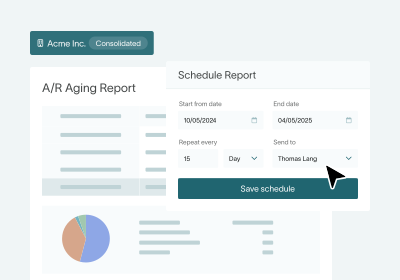
Connect patient billing, insurance claims, and collections in a single ledger. Track every dollar from service delivery to reimbursement with automated reconciliation and real-time AR aging across payers and patients.
.svg)
Built for healthcare finance teams
Revenue cycle automation
Automate charge capture, coding validation, claim submission, and payment posting. Reduce days in AR and improve cash flow with intelligent workflows that adapt to payer rules.
.svg)
Claims & reimbursement tracking
Monitor claim status, denials, and appeals in real time. Track reimbursement patterns by payer, procedure, and location to identify underpayments and accelerate collections.
Compliance-ready reporting
Generate audit-ready financial statements with full traceability. Support NDPR-aligned access controls, SOX-compliant workflows, and automated audit trails for every transaction.
.svg)
Multi-entity accounting for health systems
Hospital network consolidation
Consolidate financials across hospitals, outpatient centers, and specialty clinics. Automate intercompany eliminations, allocate shared costs by bed count or RVU, and close faster with standardized charts of accounts.
.svg)
Department-level cost accounting
Track revenue and expenses by department, service line, or facility. Use flexible allocation rules to distribute overhead, labor, and supply costs for accurate profitability analysis and budget management.
.svg)
.svg)
Automated patient billing
Generate patient statements, payment plans, and estimates automatically. Post copays, deductibles, and self-pay balances directly to the general ledger with integrated payment processing and reconciliation.
Payer contract modeling
Model payer contracts and fee schedules to identify underpayments and negotiate from data. Track actual vs. expected reimbursement by CPT code, payer, and provider group.
Regulatory audit trails
Maintain immutable audit trails for every journal, adjustment, and reversal. Support Medicaid, Medicare, and private payer audits with drill-down traceability from summary to source document.
Real-time healthcare finance analytics
Financial control without operational friction
Bring clinical operations and finance together with dashboards that show utilization, revenue per encounter, and cost per case. Empower CFOs and controllers to make faster, data-driven decisions.

KPI dashboards for CFOs
Monitor days cash on hand, net patient revenue, bad debt ratio, and operating margin in real time. Set thresholds and alerts to surface issues before they impact cash flow.

Budget vs. actual by service line
Compare budgeted and actual performance by department, DRG, or procedure. Adjust forecasts dynamically based on patient volume trends and payer mix shifts.

Healthcare Finance & Accounting FAQ
LEDGER connects billing, claims, and collections in one platform with automated posting, real-time AR aging, and payer-specific tracking to accelerate reimbursement and reduce write-offs.
Yes. LEDGER consolidates unlimited subsidiaries with automated intercompany transactions, cost allocations, and elimination entries — all while preserving local statutory reporting requirements.
LEDGER provides role-based access controls, immutable audit trails, and configurable workflows that align with HIPAA privacy requirements and SOX internal control standards for healthcare organizations.
LEDGER automates statement generation, payment plan scheduling, and copay posting with integrated payment reconciliation. Patient balances sync directly to the general ledger in real time.
Track days cash on hand, AR aging, net patient revenue, bad debt ratio, cost per discharge, operating margin, and payer mix with configurable dashboards and automated variance alerts.
Yes. LEDGER supports flexible allocation rules by RVU, square footage, headcount, or bed count. Automate recurring allocations and generate journal entries with full audit trails.
Model expected reimbursement by fee schedule, then compare against actual payments. LEDGER surfaces underpayments and denials by payer so finance teams can recover revenue and renegotiate contracts with data.